
Can Cats and Dogs Live Together Peacefully?

Cuddle Buddies
Our pets, Lucy and Hunter, can often be found sharing a cozy blanket for a happy snuggle.
We all know that old saying, “they fight like cats and dogs”.
So many times in TV shows, cartoons and movies we see dogs chasing cats, cats giving dogs a good swat, and the general idea that cats and dogs just can’t get along.
Dogs and cats have been natural enemies for a very long time. There is an instinctual component there. They seem built to be a menace to one another.
But, more and more, households with both cats and dogs is becoming a reality. In Canada, 13% of households have both species. In the U.S., that percentage is about 16%. In the UK, it’s even higher at about 31%.
So, are we just placing two mortal enemies in the same house and just expecting them to deal with it? Sounds like trouble.
But it doesn’t have to be. Dogs and cats can co-exist. They can even be friendly with each other. Hey, they can even sleep together or groom each other, like family!
The Proof is in The Cuddle
For about 25 years, we have lived with both dogs and cats in our home. And, generally speaking, our cats and dogs have gotten along together just fine.
But this didn’t happen by accident. While every introduction didn’t go as planned, we have gotten better over the years at making sure all our pets will get along before we even brought them home and then introduced them properly to give them plenty of time to get comfortable with each other.
Our first pet was a cat named Timmins. He was a feisty fellow and had never been exposed to other animals since kittenhood.
When we moved out of an apartment and into a house, we adopted Piper, a 16 month-old Lab who had been through guide dog training but was too hyper to be placed in a guide dog position. She was full of energy, but good with cats.
Her reaction to Timmins was curiousity and enthusiasm. Timmins reaction was horror.
He retreated to the safe space we had created for him and slowly emerged at his own pace. But I do wish we’d handled the first meeting better.
However, we did, at least, ensure that Piper was friendly to cats and trained to leave them alone and that Timmins had plenty of safe areas to retreat to in our home. They learned to tolerate each other, if not be fast friends.
When Timmins passed away several years later, we moved to a new home in the country and brought home a kitten that we named Hunter. While Hunter responded to meeting Piper with an arched back and hiss or two, Piper gave him a respectful distance and they quickly adjusted to each other.
Then, when Piper passed, we adopted Jack, a 3 year old, high energy Border Collie-Lab cross. Jack had been exposed to other cats and knew to give them space so it didn’t take long for Jack and Hunter to be comfortable with each other.
Though Jack had a high prey drive and would torment the local chipmunk population, he never bothered Hunter at all. It helped that Hunter had been socialized with Piper and never ran away to prompt a chase.
Then, shortly after that, we brought home Lucy, our yellow Lab. Lucy had been through guide dog training and was well-socialized. When we met her, we got to see her with a cat at the training facility and she was very curious but respectful.
Within less than a day of bringing her home, Hunter emerged from his safe spot and was almost instantly comfortable with Lucy and her calmer energy level.
When Jack passed away, Lucy and Hunter became even closer.
The result is, they can often be found cuddling on the same blanket or sofa, or sharing a fresh bowl of water. There is no chasing, no hissing, no growling, no barking, no claws-out swatting, no fighting over toys or treats. Just two “mortal enemies” existing as close companions.
So, how did this happen? Let’s talk about it.
Disclosure: As an Amazon associate, this post contains affiliate links. If you follow one of these links and make a purchase, I may earn a commission, at no extra cost to you. This helps support this blog and my ability to keep bringing you important articles regarding the care and life enrichment of your precious fur kids.

Hunter Staking His Claim
While Jack was surprised by Hunter joining him on the sofa for the first time, he stayed calm and let Hunter sit beside him.
Choosing Your Pets
If you plan on having a multi-species pet home, there’s probably things you will need to know when you choose your pets.
For instance, if you’re interested in a dog that shows signs of prey drive, resource guarding, or aggression, this is going to make integrating them into your home much more difficult.
You will need to either choose a different pet or be very open and able to get help.
Yes, it’s possible. But not advised without professional help and a huge commitment. That’s probably something that the average person would want.
Also, it may not be fair or safe for your other pets.
If you’re going to introduce a new pet to your pet household, you should know the following about both your pet and the pet you’d like to adopt:
Do they have a high prey drive(dogs)?
Do they show any signs of resource guarding or are they territorial?
Have they lived with other animals before?
Have they lived with other species before?
What is the energy level and playtime style of the pets?
Are they fully up-to-date on vaccinations?
Has the dog had obedience training and been taught commands such as “leave it”, “down”, “place” and “stay”?
You should also consider whether you have a space where you can isolate your new pet, give your cat a safe spot to escape once face-to face intros are made, even if it’s just higher ground, and whether you have the time to devote to making slow introductions and monitoring your pets carefully to ensure everyone’s safety.
The Slow Introduction
When you’re getting ready to bring home the new pet, you will want to give them their own space to stay in while they decompress and adjust to their new surroundings. If you have to choose, give your current pet as much room as possible so they don’t feel their territory is being taken away.
Keep the dog and cat in separate rooms with a door between them. Ensure they both have access to food, water, their bedding, and a litter box for the cat. Let them smell each other under the door with no physical contact.
You can bring bedding or toys from the other pet for them to smell. Give them high-value treats at the door or with the other pet’s belongings as a positive reinforcement associated with the other pet’s scent.
When both pets have settled and are relaxed, which could take days, especially for the new pet, you can start to further the introduction process.
Use pet or baby gates to let them see and smell each other fully without being able to reach each other. Keep monitoring them and reinforcing desired behaviours with treats and praise.
Curiousity and interest in each other is perfectly normal and healthy. Fixation, hard staring, and high excitability is not.
Hissing, growling, high-pitched barking, lunging and snapping should signal the time to take it back a notch.
When they can meet through the baby gate calmly, you can put your dog on leash, and your cat, if they’re accustomed to it, and let them meet face to face. Watch for signs of conflict and be prepared to separate them quickly. Stay calm but watchful.
Make sure the cat has a means of escape. If they can access higher ground such as a cat tree or shelving, or another room that the dog can’t get to, they will feel safer. A cat that feels unsafe is more likely to turn and become aggressive.
For a while, until everyone, including yourself, feels comfortable, do not leave them in the same space without your presence. This could take days or even weeks for some pets.
Give them their own space, separated with gates or even doors, to ensure the safety of both pets when you’re not around. Then, practice positive reinforcement training with both pets.
If there are any setbacks, separate them until they are calm again and repeat the above steps until they’re able to comfortably co-exist.
If they’re unable to get along, you may have to get some help from your veterinarian, an animal behaviorist or a trainer to find a solution. Be cautious, be patient, and don’t give up hope.
Also, if you find that your cat is especially stressed, you can try a Feliway calming diffuser that uses synthetic cat pheromones that can help cats feel less anxious, safe, and secure in stressful situations.
If your dog is the anxious one, you can use ThunderEase or Adaptil. These products are species-specific so they won’t affect the other pet species or your family.
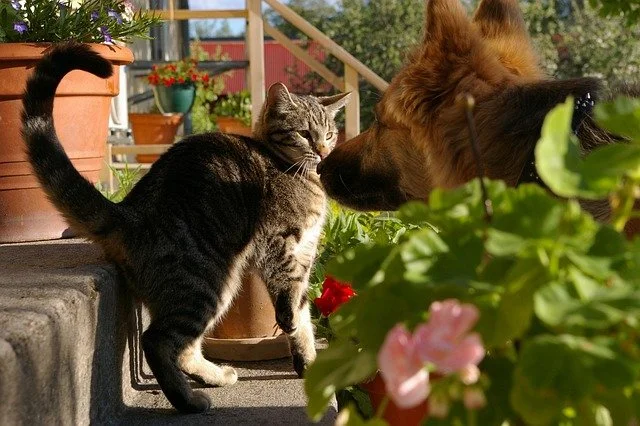
A Wary Greeting
Ensure that you monitor your pets together to limit conflicts in the early introductions.
Reasons for Conflict
There are several reasons why conflict can arise between dogs and cats. You should keep them in mind if you see any signs of a clash between them.
Instinct- Dogs can naturally have a prey drive instinct that will cause them to get excited and/or chase a smaller animal. Cats can have the instinct to aggressively defend themselves against an animal that they interpret as a predator.
Fear- This is definitely a big factor. A dog’s exuberance to check out this new creature can frighten a cat and they will respond in different ways. They may simply run or jump to higher ground. They may also puff up their fur and arch their back to look bigger, hiss, growl, and, if pushed too far, swat or even attack the dog. Dogs can also be fearful and defensive.
Miscommunication-This one makes total sense. Dogs and cats communicate in very different ways. If a dog wags its tail, it’s a sign of friendliness or happiness. A cat’s tail sweeping is a sign of irritation or anger. A dog’s nervous or fearful pinned back ears can be a sign of anger and aggression to a cat. Even a cat’s purr could be interpreted by a dog as a low, warning growl by a nervous dog.
Territory-If you are bringing one animal into another animal’s territory, there’s bound to be some adjustment period. Even you, as the provider of food, care, and affection can be thought of as part of a pet’s territory so you should ensure that equal attention is given to both pets. Cats, especially, can be territorial about their domain, while dogs may show more signs of “jealousy”.
What to Do If Conflict Arises
While most dogs and cats can learn to live in harmony, there may be some rough patches at the beginning of their relationship. Make sure that your cat can escape to safer, higher ground or another dog-free space.
Don’t punish your dog for it’s natural curiousity or even prey drive or a cat for aggression as this will make the problem even worse. Use positive reinforcement training instead.
Best case scenario will be that they learn to get along or, even better, will quickly learn to trust each other. But they could also learn just to ignore each other and stay out of each other’s way.
If both your dog and your cat are continuing to struggle with appropriate behaviour around each other, you should speak to your veterinarian or an animal behaviourist to get advice and the help you will need to make this work.
