
Collar, Halter or Harness: Which One is Best For Your Dog?
When it comes to using the proper equipment for controlling your dog, there are so many choices and maybe even more opinions.
If your dog pulls on their leash, especially if they are stronger than you, the decision can be especially difficult. While dogs can be trained to walk without pulling, it can take a lot of patience and you need to walk your dog safely in the meantime.
The fact is, if your dog is pulling you off your feet every time they see something interesting, or almost impossible to pull away when you’re trying to get them out of danger, you and your dog are going to be frustrated and those walks may become something you dread.
You also don’t want to injure your dog just by trying to control them or keep them out of danger. But, the reality is, with the wrong tool, this can happen.
So, you ask the question…Is a collar, a harness, or a halter the best tool?
You will find a plethora of advice. There will be no shortage of that.
But, the question isn’t which tool is the best…the question is which tool is best for your dog?
Disclosure: As an Amazon associate, this post contains affiliate links. If you follow one of these links and make a purchase, I may earn a commission, at no extra cost to you. This helps support this blog and my ability to keep bringing you important articles regarding the care and life enrichment of your precious fur kids.
The Options

For most dogs, collars are just for basic at-home control and holding their ID tags, but it depends on the dog
Collars
There are so many different kinds of collars that you can use for dogs and their training. The typical flat collar or martingale collar(made of nylon, leather, polyester, biothane, and cotton) is best used for the most basic of training and for holding ID, license, and medical tags.
There are also metal choke collars, pinch collars, and prong collars, though most trainers are easing away from their use and focusing on positive behaviour re-inforcements instead of behaviour corrections.
E-collars are also an option for off-leash control. These aren’t the “shock collars” they used to be and can be very effective for training. However, the truth is, I’ve had very little exposure to e-collars so I have no opinion about their effectiveness or anything else about them.
Besides, for the purpose of this article, I’m sticking to tools that are recognized as being compliant for leash laws. E-collars are not considered leash law compliant in most jurisdictions.
If your dog is well-mannered on leash and walks with a loose leash by your side and never pulls, you may be able to get away with just a collar.
But, if your dog has a delicate throat, breathing issues, or is a heavy puller, using a normal collar while walking or training your dog can cause severe pain and injury to your dog.
Save the collar for simple training at home. They can also often be used in conjunction with harnesses or halters so you can have their ID tags on your dog at all times.
Top Picks:
1) Regal Biothane Collar- I absolutely love a biothane collar. They are waterproof, come in bright colours, chew resistant, easy to clean, and practically indestructible. My dogs have worn them for years with very little sign of wear and tear.
2) Light-up Collar- These collars are great for walking your dog at night to stay safer or simply for keeping track of them in your yard when you let them out for a 3am pee break. They are bright LED collars that are rechargeable, colour-changing and waterproof and easily buckle up with a quick-release button.
3) Gooseman’s Gear Collar- This collar is for the large, energetic pup who doesn’t know their own strength. Built with double-layered nylon and metal hardware that can withstand more than 350lbs of force. If you have a dog that can break out of its collar(and they do exist, believe me), you will appreciate this collar. But that metal hardware also includes a quick-release mechanism so you can easily remove the collar when desired.
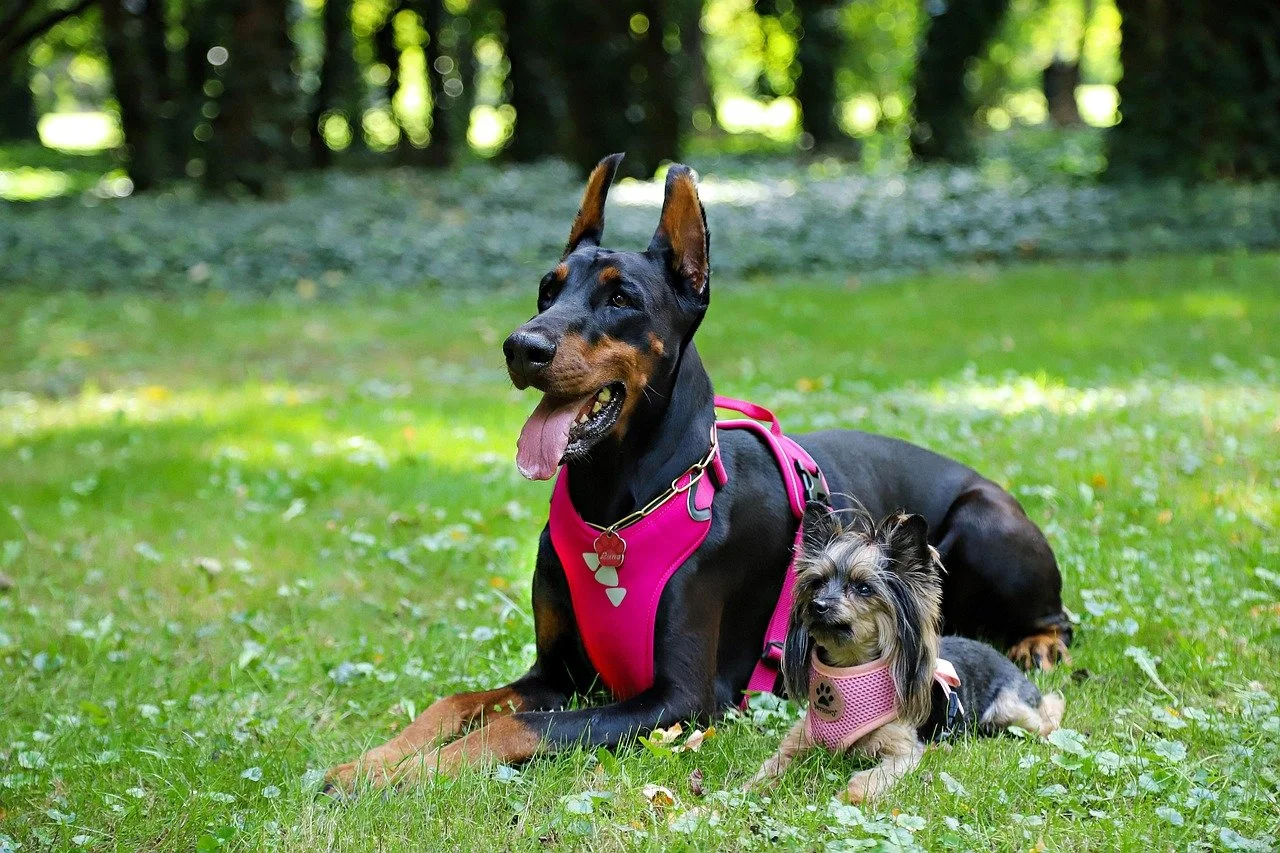
A large dog and a little dog can both benefit from a well-fitting harness
Harnesses
Harnesses are great for heavy pullers and small breeds with delicate necks because they distribute the pressure across the dog’s chest and shoulders, reducing the risk of injury.
They are more difficult to slip out of, making them safer for fearful or reactive dogs or when travelling.
As with collars, there are many, many options. It’s important to know what your goals are when you put your dog in a harness.
There are harnesses made specifically for dogs who pull too hard that have a lead that attaches to the front of the chest instead of the back.
Perhaps you want a harness that is vehicle-safety tested. Having a harness that can be hooked to your car’s seatbelt buckle can save your dog’s life in a crash and can also keep your dog from becoming a projectile.
It can also keep your dog in one place so they don’t leap out of your car or prevent an accident in the first place by interfering with your driving.
A disadvantage to harnesses is that they provide less directional control for your dog when you’re walking or training them. A front attachment point harness does help with this but you need to learn to use it correctly.
A harness can also give a lot of leverage to a large, strong dog. Think “sled dog”.
If a dog is in a harness and decides to run and the person at the other end of the leash isn’t trained properly or is out-muscled, they may just become the sled!
Harnesses can also be a little tricky when it comes to adjustment and fit. Because every dog is different, you need to be able to adjust the harness properly so that it fits comfortably, allows for freedom of movement, but still firmly remains on your pup’s body.
For most dogs, some form of harness will be a great choice to keep them well under control, safe and comfortable.
Top Picks:
1) Kurgo Tru-Fit Enhanced Strength Harness- This harness is crash-tested and certified for dogs up to 75lbs. It has 5 adjustment points and a broad chest plate to make it as comfortable as possible for your dog. It includes a safety tether to buckle your dog securely and both a back and chest D-ring attachment point for the leash when walking. Great for both car safety and walking.
2) PetSafe Easy Walk Harness- This harness is designed specifically to teach your strong-pulling dog to stop pulling. With a martingale loop and front chest leash attachment, you can gently guide your dog. It’s lightweight, comfortable and easy to adjust for a proper fit. It even has a different coloured belly strap to make it easy to put it on the right way.
3) Noxgear LightHound Harness- If you’re looking for a basic harness with a back leash attachment that you can use at night for safety, this is the harness for you. Change between 8 different colours and 6 lighting patterns to really catch the eye. The rechargeable battery is long-lasting for up to 12 hours. As an added bonus, if you already have a harness or other gear, it can easily be slipped on over a collar, harness or jacket and not interfere.

Dog halters can be effective training tools for some dogs
Halters
A head halter might be a better option for strong, reactive, or large dogs that pull hard on their leash, especially if you are not as strong as your dog.
The saying is that where the nose goes, the body follows. Halters are based on this logic and can be used to gently guide your dog.
If your dog outweighs or out-muscles you, a halter can give you mechanical leverage to pull them away from their intended direction without harming them or yourself.
In general, a harness is more for everyday walking but a halter can be a very useful training tool to keep your dog focused on you and gives you the ability to quickly respond to triggers, easing your dog away before they have a chance to respond.
While there are many advantages to using the halter, there are some disadvantages or situations that may not work for you and your dog.
Firstly, most dogs don’t enjoy pressure on their snout. They will need to be slowly desensitized using high-value treats and positive re-inforcement.
Like collars, they can’t be used for car safety. Seatbelts and safety tethers must be attached to a body harness, not a halter.
Some halters can be dangerous for dogs that lunge unexpectedly with a potential for neck strain. You need to be aware how your dog behaves and anticipate these triggers before your dog reacts.
They shouldn’t be used with extendable leash or long lines. If your dog runs and reaches the end of the rope at full speed, severe injury to the neck or spine can occur.
Dogs with short snouts, such as boxers or pugs, or particularly delicate necks, such as greyhounds, are not good candidates for a halter. They aren’t necessary for small dogs that you outweigh and out-muscle.
Top Picks:
1) Gentle Leader Halter -This is the halter we use for Lucy. It was used in her training to be a guide dog. The halter is easy to fit with a quick-snap neck strap, is minimal in design to keep your pet cool, and has a neoprene padded nose loop for comfort.
2) Halti Headcollar- Another great choice for your dog. This halter has an extra safety strap to attach to a collar in case your dog is able to pull the strap off their nose. It’s also reflective for extra safety at night.
3) GoodBoy Head Halter- This halter is similar to the Halti but has a safety strap that attaches to your dog’s collar at the back of the neck, instead of at the front so it doesn’t dangle around your dog’s chin. With lots of padding and some extra adjustment points for the side straps, this halter can be made to fit your dog for maximum comfort.
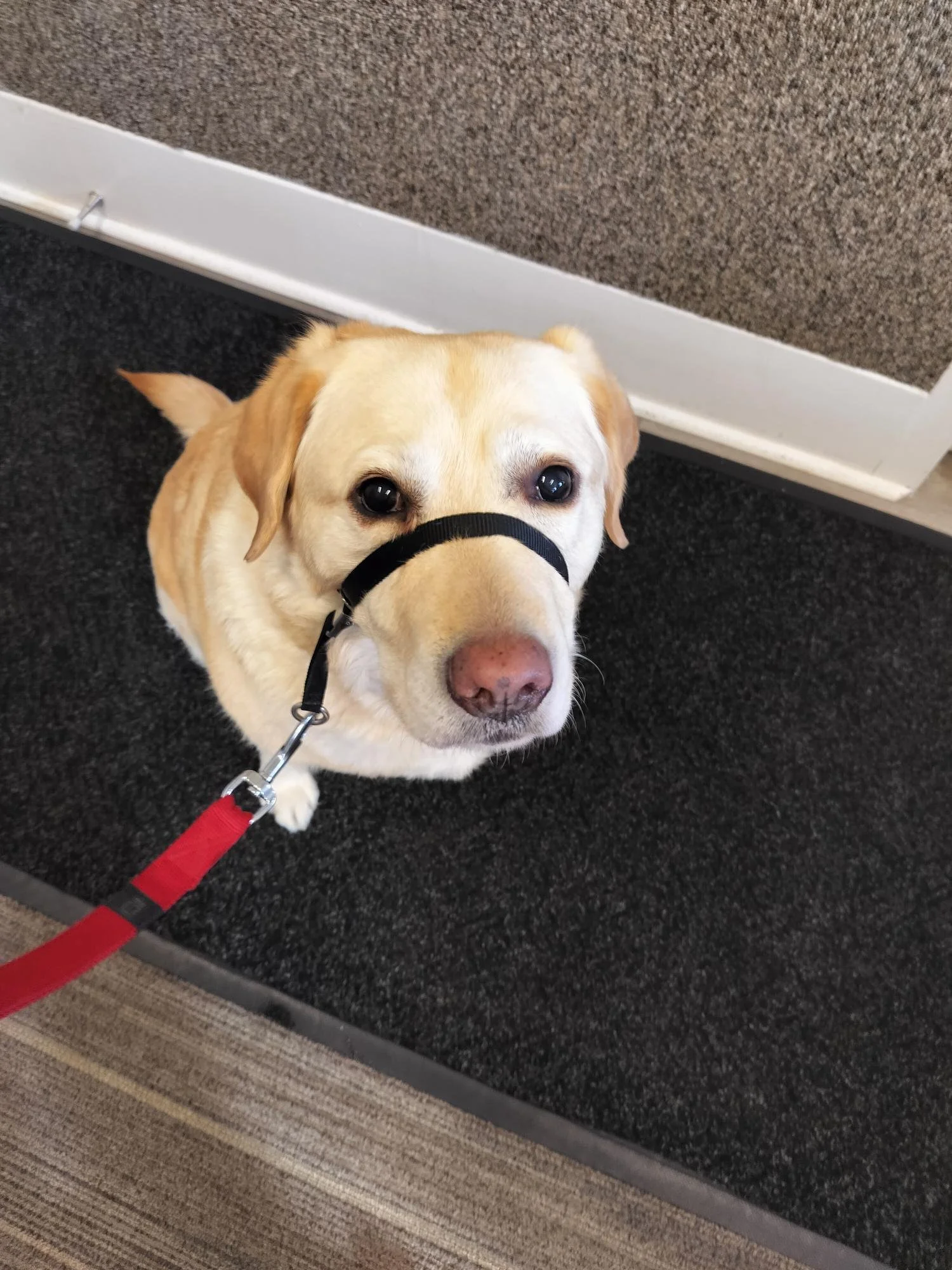
Lucy at her last vet visit, looking adorable, as usual
A special note about our experience with halters:
All three of our dogs used a head halter at some point in their lives.
Piper was a guide dog trainee and she came trained to the halter when we adopted her. This was fortunate because she was a very large and strong Lab who pulled her way through every walk, even as a senior dog.
Jack would wear the halter occasionally but he didn’t really take to it and was uncomfortable wearing it so I stopped using it with him. Like any tool, its effectiveness will depend on your dog.
Our dog, Lucy, was trained from a young age to use a halter in her guide dog training. After her career change, once we adopted her at the age of 2 years old, we didn’t really keep up with using the halter. She pulled hard on the leash at the beginning of the walk but eventually settled down so we didn’t bother.
Recently, I started using the halter again and I am kicking myself for not sticking to it all along. Lucy is actually much more relaxed with the halter and doesn’t even try to pull. I find that makes me more relaxed and I let her have her head to sniff about when she wants.
Before, she was pulling for every little sniff and it became frustrating and not so fun. I got tired of being dragged into bushes and toward any dog she met on the walk. She got tired of me not letting her.
She behaves better around other dogs now. She LOVES other dogs but can be over-exuberant when she encounters them. With the halter, she still loves to meet new friends, but she doesn’t lunge when she sees one. She calmly walks by dogs who don’t want that encounter but is still able to greet the friendly ones in a much calmer way.
Conclusion
The best choice between a collar, harness, or halter is the one that works for your needs and the needs of your dog. With so many choices, I understand the confusion.
It may take some trial and error. But you can find the one that works for your dog by knowing what you want and understanding what your dog needs so everyone is happy and safe!
